Concepts
The following is a list of concepts or keywords that are used throughout the documentation.
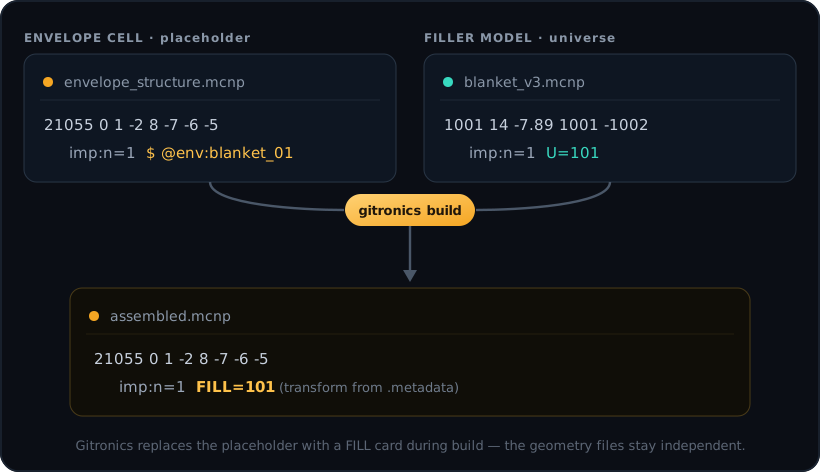
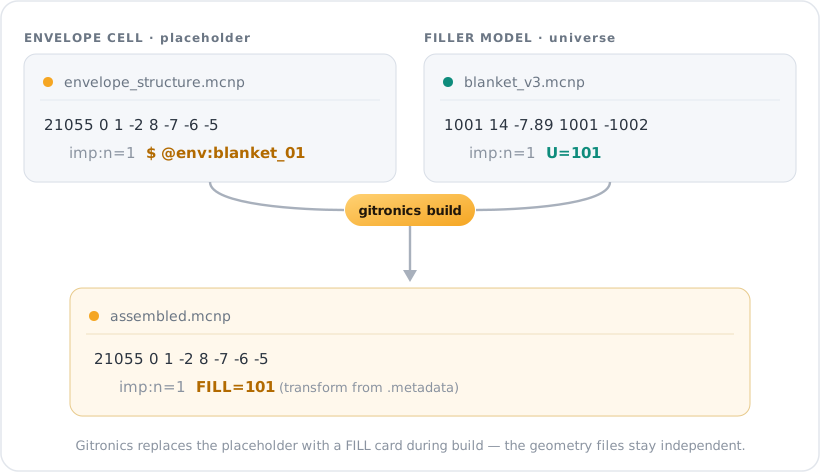
FILL card in the assembled model — while the source files stay independent.- Gitronics. The name of the tool and methodology.
- Gitronics project. A reactor/s or other nuclear project that is managed with the Gitronics methodology.
- Git. A distributed version control system that is used to track changes in the files of a Gitronics project.
- Reference model directory. A directory containing files that can be used to assemble an MCNP model.
- Assembled model. The output of the
gitronics buildcommand, a single MCNP input file generated from a configuration file and the contents of the reference model directory. - Configuration file. A YAML file that declares which filler models and data cards are used to assemble a model.
- Envelope structure. An MCNP input file that defines the level 0 geometry cells, that is, cells that do not belong to a filler universe. It is the only mandatory file in a Gitronics project.
- Envelope cell. A MCNP cell that can be filled with a filler model. They are defined in the envelope structure file as cells with an inline comment of the form
$ @env:<envelope_name>, where<envelope_name>is the name for the envelope cell. - Filler model. A MCNP input file that defines a filler universe, which is a set of geometry cells that can be inserted into an envelope cell. A filler model must have a metadata file with the same name and the
.metadataextension. - Data card file. A file that contains MCNP data cards, such as materials, sources, tallies, transformations or others. These files can have the following extensions:
.mat,.source,.tally, or.transform. - Metadata file. A YAML file that contains metadata related to a geometry or data card file. A metadata file must have the same name as the file it describes, but with the
.metadataextension. These files are optional except for filler models and they can hold any arbitrary information.