How it works
Overview
InterpCore maps values known on a source point cloud (e.g. the integration points of an electromagnetic or CFD model) onto a destination point set (the nodes or the element centroids of a mechanical FE model). The neighbour query is computed only once, in the constructor, since all source files are assumed to share the same coordinates.
Two mapping philosophies
Kernels fall into two families, depending on which point set the KDTree is built on and on which point set the loop runs.
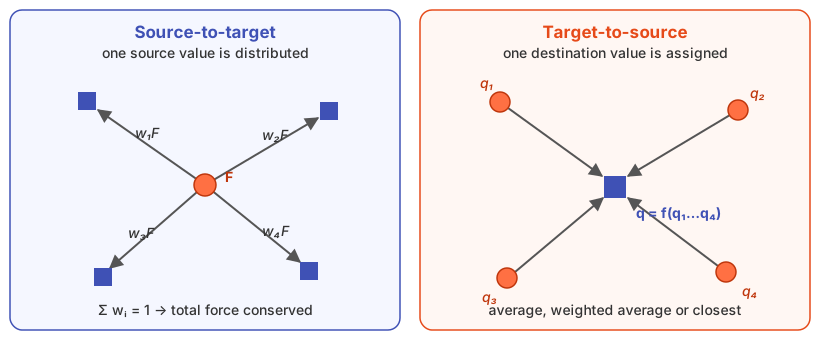
Orange circles are source points, blue squares are destination points.
| Source-to-target | Target-to-source | |
|---|---|---|
| KDTree built on | destination points | source points |
| Loop over | source points | destination points |
| Each iteration | distributes one source value to its destination neighbours | assigns one destination value from its source neighbours |
| Contributions | accumulate (+=) |
assigned once (=) |
| Conserves | the total (sum) of the field | the local intensity of the field |
| Kernels | DISTANCE_WEIGHTED, FEM |
AVERAGE, AVERAGE_WEIGHTED, CLOSEST |
| Loads | EM_FORCE |
HEAT_FLUX, HEAT_GEN, HTC |
Forces are extensive quantities: the sum of the nodal forces must equal the total force of the source, so each source force is split among the destination nodes. Heat flux, heat generation and HTC are intensive quantities (densities): each destination point must receive a representative local value, regardless of how many source points are nearby.
Per-point decision flow
For every point of the loop, the following logic is applied
(see interpolate_block):
flowchart TD
    A[Point of the loop] --> B{Neighbours found<br/>by the query?}
    B -- no --> N
    B -- yes --> C[Discard neighbours farther<br/>than max_distance]
    C --> D{Any neighbour left?}
    D -- no --> N{Philosophy}
    N -- source-to-target --> U[Add value to<br/>unmapped total]
    N -- target-to-source --> E{accept_no_neighbor?}
    E -- yes --> Z[Assign 0]
    E -- no --> R[[Raise InterpolationError]]
    D -- yes --> F{"Closest neighbour within<br/>coincidence_tolerance?"}
    F -- yes --> G[Copy the value directly]
    F -- no --> H[Apply the kernel]
Unmapped values
With source-to-target kernels, a source point with no destination neighbour within
max_distance is not lost silently: its value is added to an unmapped total,
reported by compute_EM_resultants as
Unmapped_EM_Force.