Interpolation kernels
The kernel defines how the value of a point is computed from its neighbourhood, once
the neighbours have been found by the query and filtered by
max_distance. Kernels belong to one of two
families.
In the following, \(d_i\) is the distance between the current point and its \(i\)-th neighbour, and \(N\) is the number of neighbours.
Inverse distance weights
DISTANCE_WEIGHTED and AVERAGE_WEIGHTED use normalised inverse distance weights:
The closer the neighbour, the larger its weight.
Source-to-target kernels
Each source point distributes its value \(\mathbf{F}\) to its destination neighbours. The contributions coming from different source points are summed on each destination node.
DISTANCE_WEIGHTED
Since the weights sum to one, the total force is conserved exactly. Each component is split independently, so the direction of every nodal contribution is the same as the direction of \(\mathbf{F}\).
FEM
The source point is connected to each of its destination neighbours by an axial spring with stiffness inversely proportional to its length, with the destination nodes fixed. The force \(\mathbf{F}\) is applied to the source point and the reaction forces of the springs are the nodal forces.
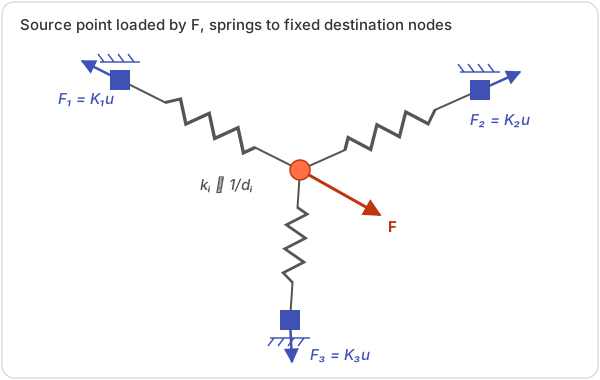
With \(\mathbf{e}_i\) the unit vector from the source point to neighbour \(i\):
The nodal forces sum to \(\mathbf{F}\), so the total force is conserved. Unlike
DISTANCE_WEIGHTED, each nodal force is aligned with its spring, so the distribution
depends on the geometry of the neighbourhood.
Warning
The \(3\times3\) stiffness matrix is singular when all neighbours are aligned or coplanar with the source point (e.g. very few neighbours or a 2D-like neighbourhood). In that case no force is distributed for that source point. Use enough neighbours (K ≥ 4 is a reasonable minimum) to avoid it, and check the resultants.
Target-to-source kernels
Each destination point receives a value \(q\) computed from the values \(q_j\) of its source neighbours.
AVERAGE
AVERAGE_WEIGHTED
CLOSEST
The value of the closest source neighbour is copied. This is useful when source and destination points are close to each other, or when sharp gradients should not be smoothed.
Kernel–load compatibility
| Kernel | Family | Compatible loads |
|---|---|---|
DISTANCE_WEIGHTED |
Source-to-target | EM_FORCE |
FEM |
Source-to-target | EM_FORCE |
AVERAGE |
Target-to-source | HEAT_FLUX, HEAT_GEN, HTC |
AVERAGE_WEIGHTED |
Target-to-source | HEAT_FLUX, HEAT_GEN, HTC |
CLOSEST |
Target-to-source | HEAT_FLUX, HEAT_GEN, HTC |
Using an incompatible combination raises a ConfigurationError when the
InterpolationConfig is created.